The Industry's Leading Wi-Fi HaLow SoC
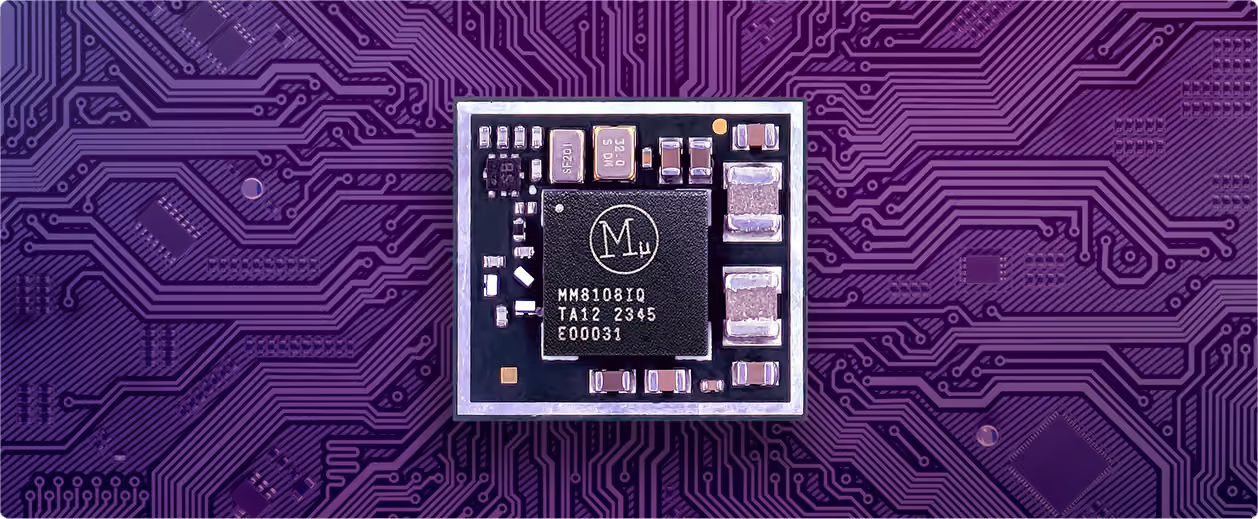
Morse Micro's MM8108 delivers the fastest Wi-Fi HaLow data rates, up to 43.3 Mbps PHY, with the industry's best transmit-power efficiency in the smallest chip and module footprint available.
What the silicon delivers
Wi-Fi HaLow operates at a lower frequency than other Wi-Fi, giving it up to 10× the range of conventional and 2× to 5× times better penetration through walls, floors, and obstructions. Morse Micro silicon carries higher data rates than any other dedicated long-range wireless network technology, delivered by the world's first sub-1 GHz 256-QAM physical layer, providing enough for security camera video and real-time device data at distances conventional Wi-Fi cannot reach.
In addition to reach, Morse Micro has built in advancements in power efficiency, interference mitigation, and connection reliability. Our SoCs support the standard Wi-Fi power-save modes and WPA3 security in a single-chip Wi-Fi HaLow solution.
The Morse Micro Wi-Fi HaLow chips
Morse Micro makes two Wi-Fi HaLow SoCs. The MM6108 was the fastest, smallest, longest-range, and lowest-power Wi-Fi HaLow chip available at its release. The MM8108 is the second generation, and improves on all four metrics.
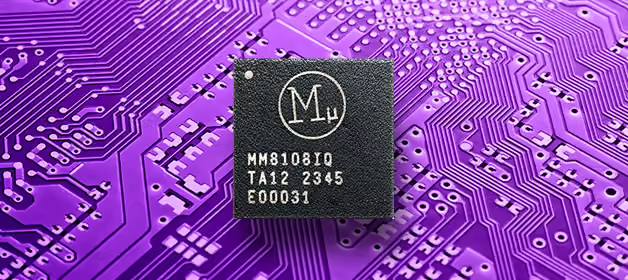
MM8108
- Peak throughput (PHY)43.3 Mbps
- PackageBGA, 5 × 5 mm
- Front endIntegrated PA and LNA
- Regulatory coverageIntegrated single global SKU
- Software modelsSoftMAC, FullMAC
- Host interfacesSDIO 2.0, SPI, USB 2.0
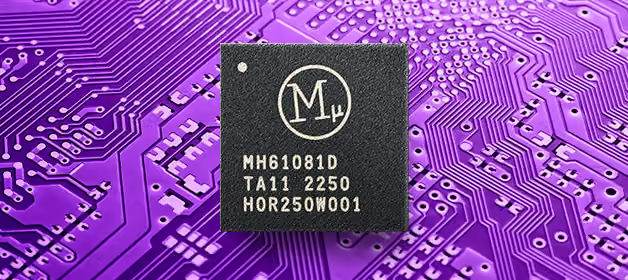
MM6108
- Peak throughput (PHY)32.5 Mbps
- PackageQFN, 6 × 6 mm
- Front endExternal PA and LNA required
- Regulatory coverageExternal regional front end
- Software modelsSoftMAC
- Host interfacesSDIO 2.0, SPI
Wi-Fi HaLow is Wi-Fi
It behaves like Wi-Fi, because it is Wi-Fi. Native IP support means no protocol translation gateway, with the same network stack, tooling, and engineering skills your team already has.
Over-the-air firmware updates.
Enough bandwidth to update firmware across the whole fleet in the field, which low-data-rate long-range radios cannot practically deliver.
Certified and interoperable.
Wi-Fi HaLow is IEEE 802.11ah, certified by the Wi-Fi Alliance as Wi-Fi CERTIFIED HaLow. Certified products interoperate across vendors, so there is no single-supplier lock-in.
Wi-Fi-grade security.
The full Wi-Fi security framework built in: WPA3, Protected Management Frames, and Opportunistic Wireless Encryption, with AES and SHA-2 encryption handled in dedicated on-chip hardware.
Easy build and integration
It behaves like Wi-Fi, because it is Wi-Fi. Native IP support means no protocol translation gateway. The same network stack, tooling, and engineering skills your team already has.
Software and host support.
A common SDK, Linux driver, and OpenWrt work across both chips. On Linux, the driver builds on the standard Wi-Fi stack your team already uses (cfg80211, mac80211, wpa_supplicant, hostapd); for microcontroller hosts, the FreeRTOS-based MM-IoT-SDK provides the driver, MAC, and supplicant.
Integration flexibility.
Choose how much to offload to the silicon, from host-driven operation to a largely autonomous radio that wakes the host only when there is data to move. The higher-offload modes, including FullMAC, run on the MM8108.
Reference designs.
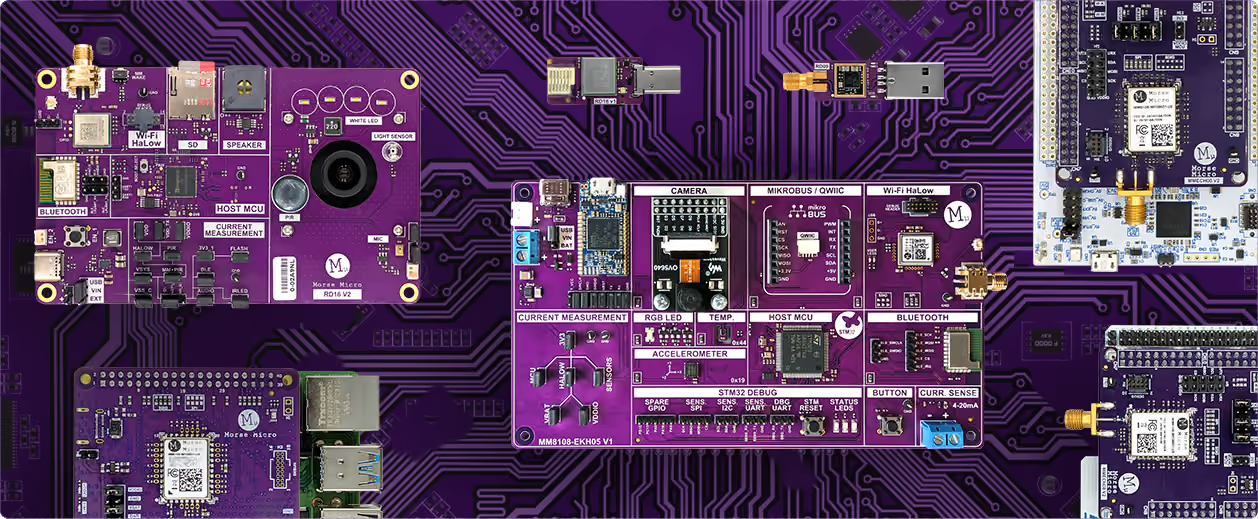
Start from a proven design, not a blank sheet. Our reference designs cover common device types, including USB and driverless dongles, security cameras, and high-power access points, each intended as a design starting point.
A supported ecosystem.
Module partners to take your design into mass production, evaluation and development kits to test and build on, and OpenWrt and GitHub support with an active developer community underneath. Support for every stage of development.
Wi-Fi HaLow from the team who helped define it
Morse Micro has been designing Wi-Fi HaLow silicon since before the certification program existed, and delivered one of the first Wi-Fi CERTIFIED HaLow platforms. That radio design experience is why our implementations perform in congested RF (radio frequency) environments, not only on the bench.
As a Wi-Fi Alliance testbed vendor, our platform is part of the official test bed that other companies certify their own Wi-Fi HaLow products against.
Our silicon has been proven far beyond the lab: in independent Wireless Broadband Alliance field trials across residential, commercial, industrial, and agricultural environments, and in continuous customer trials and real deployments. Detailed performance data is available on request.
Morse Micro Products
Explore our other Morse Micro Wi-Fi HaLow products.
Common questions about Wi-Fi HaLow
Wi-Fi HaLow is a long-range, low-power version of Wi-Fi. It can connect many devices at up to 10x the distance or 100x the coverage of conventional Wi-Fi. A single access point can cover an entire home, building, or site, reach through walls and floors, and keep hundreds of battery-powered devices connected. It is genuine Wi-Fi, with the same IP networking, WPA3 security, and Wi-Fi Alliance certification, so it fits existing networks without a separate gateway or carrier.
Wi-Fi HaLow lets one network cover an entire site with fewer access points, simpler installations, and lower running costs than short-range or cellular alternatives. What that looks like in practice:
- One access point instead of several: up to 10x the range, or 100x the area, of conventional Wi-Fi, so a site that once needed numerous access points can be covered by far fewer.
- Reaches difficult locations: 2 to 5x better wall and floor penetration connects devices in basements, across yards, and behind obstacles.
- High speeds at range: over 1,000 times faster than LoRaWAN, sufficient for video, images, audio, and firmware updates.
- Low power by design: built-in power-saving features and efficient transmission reduce how often battery devices need servicing.
- Standard Wi-Fi with IP networking and WPA3 security, requiring no SIM, subscription, proprietary protocol, or translation gateway.
Wi-Fi HaLow uses the sub-1 GHz band, while the Wi-Fi in your home and office uses the higher 2.4, 5, and 6 GHz bands, and that lower frequency travels much farther and passes through walls and floors far more easily, giving up to 10x the range. Peak speed is lower, by design: Wi-Fi HaLow uses channels as narrow as 1 MHz, against the 20 MHz or more of home Wi-Fi, trading raw speed for range and efficiency. That suits the devices it is built for, like cameras, sensors, and locks, rather than high-speed uses like streaming, gaming, and laptops. Everything else is standard Wi-Fi: the same IP networking, WPA3 security, and Wi-Fi Alliance certification.
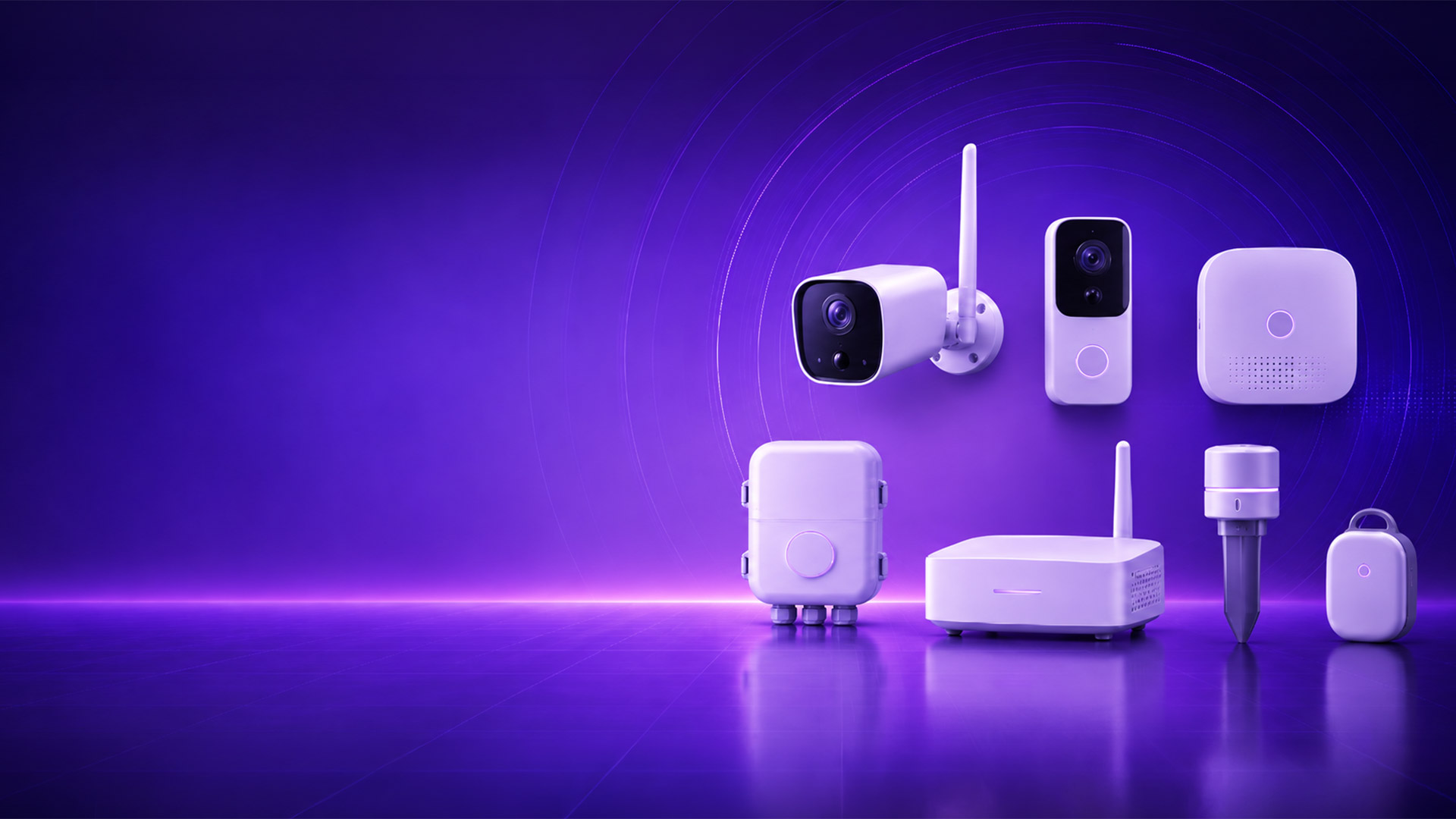
Wi-Fi HaLow suits any application where devices are spread over a large area, sit behind walls or obstacles, or run on battery power, indoors or outdoors. Common uses include:
- Homes: security cameras, smart locks, and sensors
- Buildings and campuses: access control and monitoring
- Industrial sites: asset tracking, remote sensors, and automation
- Agriculture: cameras and monitoring, plus soil, irrigation, and livestock sensors